
Escaping the Owner’s Trap: 4 Stages to Build a Business That Runs Without You
What is the Owner’s Trap?
The Owner's Trap occurs when a business relies solely on the founder's "tribal knowledge" to handle key sales calls, manage client issues, or deliver services. This creates a massive bottleneck that stalls scaling, prevents a profitable business exit, and leads to chronic founder burnout.
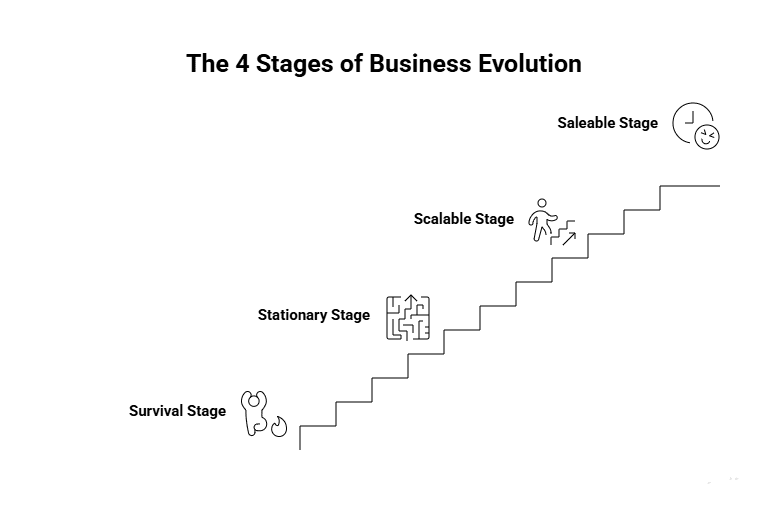
The 4 Stages of Business Evolution
To scale effectively, you must identify where your company sits on the pyramid of business systemization. Most small businesses remain stuck in the first two operational phases:
| Stage | Operational Reality | Core Characteristics |
| 1. Survival Stage | Endless loop of chasing, getting, and doing the work. | Unpredictable cash flow; founder spends 80% of time firefighting. |
| 2. Stationary Stage | Revenue achieves consistency, but processes are trapped in heads. | Owner feels like they run an "adult daycare center" managing tasks. |
| 3. Scalable Stage | Core business model is proven and backed by systems. | Founder successfully delegates core tasks to focus on strategy. |
| 4. Saleable Stage | Interdependent systems deliver precise outcomes like a Swiss watch. | Business functions autonomously, turning into a highly valuable asset. |
The Myth of the Heroic Owner
Two main psychological barriers keep founders trapped in daily operations:
- The Knight in Shining Armor Complex: Because founders are often the best problem-solvers in their companies, they step in to solve every issue. This unconsciously trains teams to remain dependent on them.
- The Documentation Myth: Founders assume they are the only ones who can build systems because they know how things should be done. In reality, visionary business owners are typically the worst people to write systems because they lack patience for granular documentation.
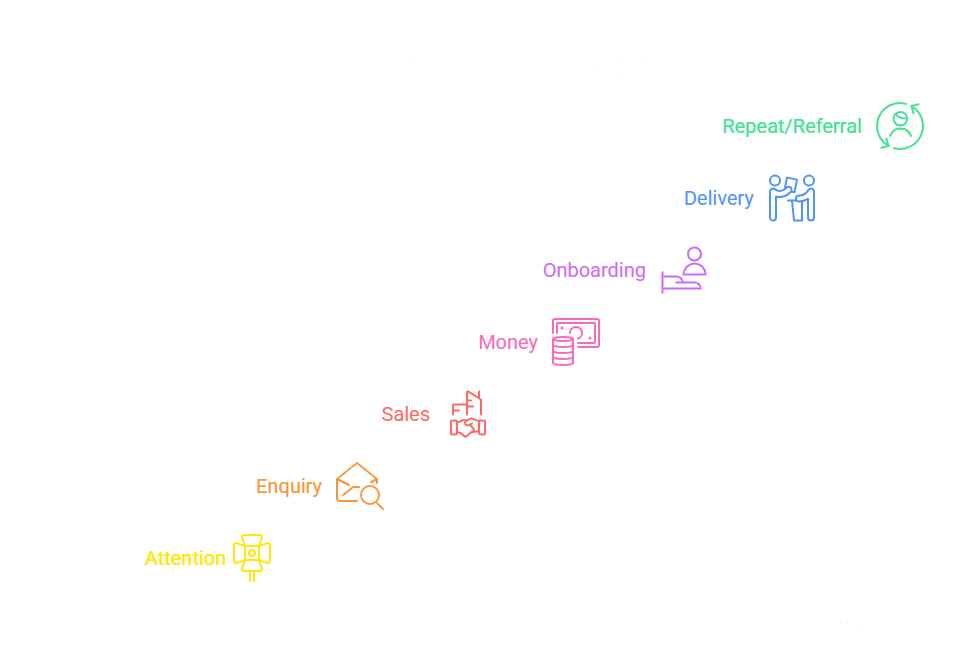
Step 1: Map Your Critical Client Flow (CCF)
You do not need to document hundreds of complex processes to achieve operational freedom in your business systemization process. The 80/20 Rule of Systems states that 20% of your systems yield 80% of your efficiency wins.
To start, isolate one primary target client and one flagship product. Then, map the linear path (usually 7 to 12 steps) required to convert prospect interest into revenue:
- Attention: How prospects discover your brand (e.g., SEO, ads, referrals).
- Enquiry: How you capture that incoming interest.
- Sales: Your structured conversion and sales process.
- Money: How you collect payments and issue invoices.
- Onboarding: Welcoming the client and managing expectations.
- Delivery: Executing the core service or delivering the product.
- Repeat/Referral: Systematically encouraging repeat business.
Mapping this flow immediately highlights operational holes, such as a lack of lead generation or poor client onboarding sequences.
Step 2: Apply the Two-Person Rule: Your Secret Weapon
To build Standard Operating Procedures (SOPs) effortlessly without adding to your workload, use the Two-Person Rule:
- The Knowledgeable Worker: The team member currently performing a task to a high standard. Their only job is to record a video or screen-share of themselves doing the task while explaining their actions aloud.
- The Systems Champion: A detail-oriented team member who reviews the raw recording and converts it into a clean, step-by-step SOP.
This completely removes the burden of writing from both the business owner and the technical expert.
Step 3: Pair Visionary Leaders with Managers
Stepping away from daily operations requires understanding the explicit difference between leadership and management:
- The Leader: Usually the founder. They provide vision, ideas, and drive, but frequently struggle to finish what they start.
- The Manager: The organizational "glue." They ensure the team follows established processes consistently.
True business scale requires a partnership. Just as Walt Disney needed his brother Roy Disney to manage the business execution, a visionary founder needs an operations-minded manager to enforce a systemized culture.
Overcoming the “Creativity” Myth
A common objection to systemization is that it will destroy creativity or turn employees into "mindless robots".
On the contrary, systems actually automate routine tasks, which creates the mental space and time required for your team to focus on high-leverage, creative growth. When the day-to-day operations are handled by a "synchronized mechanism" of systems, the business owner gains the freedom to be deliberate and strategic.
Conclusion: Building an Asset, Not a Job
Systemization is not about being as rigid as McDonald's from day one; it is about building a predictable mechanism for generating revenue. By shifting from the stationary stage to the saleable stage, you transform your business from a source of stress into a high-value asset.
The rewards for this effort are unparalleled—not just in terms of an 80% potential increase in bottom-line profits through incremental efficiency gains, but in the most valuable asset of all: your time.
Building a business that runs without you starts with a flawless strategic roadmap. Before you can systemize your daily operations, you need a structurally sound business plan that properly maps your company's growth, financial projections, and operational framework. If you are ready to stop firefighting and build a sustainable, fundable enterprise, you can connect with our Canadian business planning experts to map out your next steps.